

Traceable Ingredients in Dog Treats 2026: A Guide
Oct 05 , 2026
Table of Contents
- What Traceable Ingredients in Dog Treats Actually Means in 2026
- How to Read Dog Treat Labels and Verify Ingredient Origin
- Dog Treat Ingredients to Avoid, Single-Ingredient and Filler-Free Options
- Frequently Asked Questions
Last Updated: October 5, 2026
What Traceable Ingredients in Dog Treats Actually Means in 2026
Traceable ingredients in dog treats means every component can be followed back through the supply chain to a named supplier, with documented batch records at each stage. At Pet Bakery, we've built our production around this principle since 2004.
The term gets stretched in marketing: some brands mean they know their main protein source, others mean full traceability down to the last herb and oil, a difference that matters if your dog has allergies. True traceability requires supplier records, batch tracking (a lot number linking each treat to its ingredients) and origin verification.
Food Standards Agency guidance on food traceability sets out the legal requirement that food businesses must be able to identify where ingredients came from and who they were supplied to. Pet food sits within this framework, though enforcement and disclosure vary considerably across the market.
How to Read Dog Treat Labels and Verify Ingredient Origin
Reading a dog treat label means looking past front-of-pack claims at the ingredient list, analytical constituents and batch information. Ingredients are ordered by weight, so the first three or four entries tell you what the treat is made from.
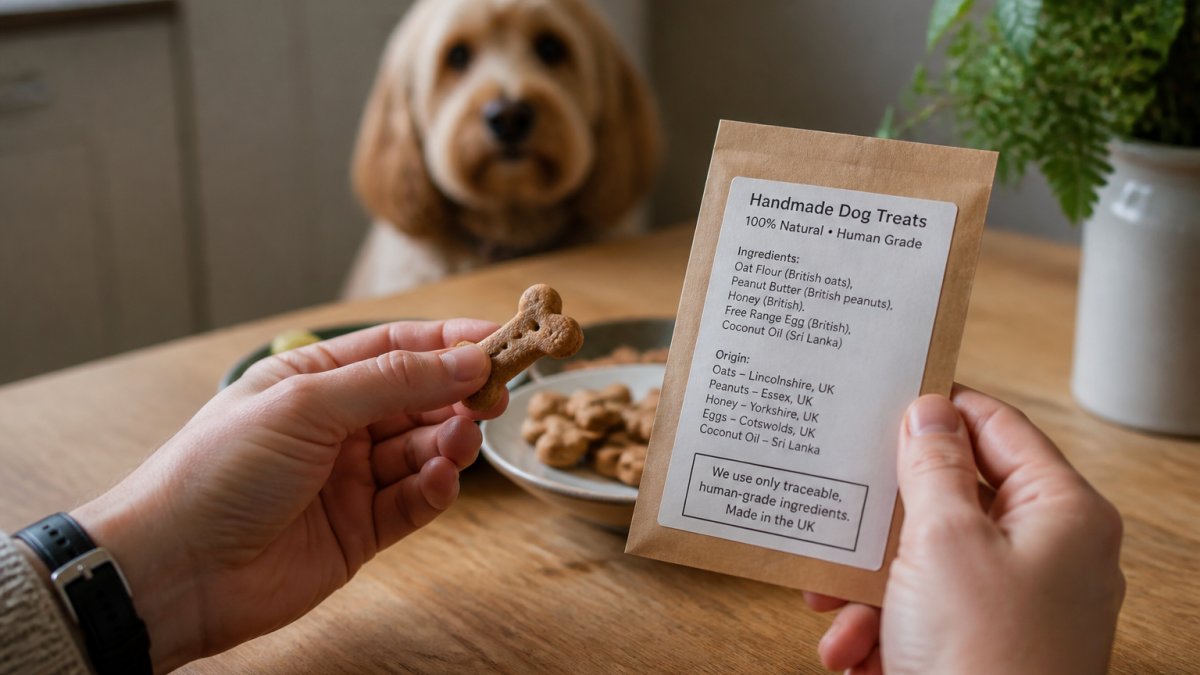
To verify origin, check for a batch code, a named manufacturer with a contact address, supplier documentation for the main protein, specific ingredient names rather than categories like "cereals" or "meat derivatives," a stated country of origin and a recognised food safety certification. A short ingredient list doesn't guarantee quality, a four-ingredient treat can still contain an unnamed protein, so ask "can they tell me where each one came from."
Our Fresh Breath Treats list every ingredient by name: rice flour, chickpea flour, rapeseed oil, parsley, ginger, chicory root, salmon oil, chicken stock and peppermint oil.

What does SALSA approval actually verify?
SALSA (Safe and Local Supplier Approval) is a food safety certification scheme recognised by major retailers and widely used by smaller producers. It requires documented supplier approval, traceability systems, batch records and recall procedures, audited regularly. Anyone can print "fully traceable" on a box; certification means someone outside the business examined the paperwork and the process.
Dog Treat Ingredients to Avoid, Single-Ingredient and Filler-Free Options
Ingredients worth avoiding include vague protein categories such as "meat and animal derivatives," artificial colours and preservatives, added sugars, and cheap cereal fillers. None are automatically dangerous, but they make origin verification close to impossible.
| Category | What to look for | Why it matters |
|---|---|---|
| Vague proteins | "Meat derivatives," "animal by-products" | Origin cannot be traced to a species or farm |
| Artificial additives | BHA, BHT, artificial colours | Not permitted in some markets, hard to verify sourcing |
| Added sugars | Dextrose, syrup, molasses near top of list | Often used to mask low-quality base ingredients |
| Cereal fillers | Unnamed "cereals," "derivatives of vegetable origin" | Bulk without declared nutritional purpose |
Single-ingredient treats are easiest to verify because there is only one supply chain. Filler-free treats take a different approach: multiple ingredients, but every one named and accounted for.
For dogs with chicken or beef allergies, look for treats built on a single novel protein or plant-based ingredients. Our Joint Care Treats combine rice and chickpea flour with turmeric, spirulina and green lipped mussel extract, with the full composition published so you can check it against your dog's triggers.

What traceability claims actually prove, and what they don't
A traceability claim proves a documented chain exists between suppliers and finished batches. It does not prove the ingredients are high quality, that your dog will tolerate them, or that the treat is nutritionally complete. Traceability is a safety and honesty mechanism, not a quality guarantee.
Batch and recall traceability makes this concrete: if a supplier flags contamination, a producer with proper batch records can pull only the affected runs, while one without them must recall everything or nothing.
UK Pet Food industry guidance on responsible sourcing outlines how manufacturers are expected to document ingredient provenance and maintain recall readiness. Cross-border sourcing adds another layer: where an ingredient is grown, where it is processed and where the finished treat is made can all be different countries, and country-of-origin labelling rules apply at each stage.
Frequently Asked Questions
What does ingredient traceability mean in dog treats?
Ingredient traceability means a producer can document where each raw material came from, who supplied it, and when it entered the batch. For dog treats, this covers the protein source, oils, flours and any functional ingredients such as parsley or turmeric. A traceable supply chain lets a maker identify a specific lot number if a problem arises and issue a targeted recall rather than pulling every product. It also gives you, the buyer, a way to check origin claims against supplier records rather than trusting a label statement alone.
How can I check where the ingredients in dog treats come from?
Start with the ingredient list: a transparent brand names each ingredient rather than grouping them under vague terms. Then look for origin information, batch or lot numbers, and a named quality standard such as SALSA approval. Ask the maker directly whether you can see supplier documentation or test results. A producer with nothing to hide will share certificates or explain their supplier verification process. If a brand cannot answer basic questions about sourcing, treat that as a signal to look elsewhere.
Are single-ingredient dog treats safer for dogs?
Single-ingredient treats can suit dogs with allergies because there is less to react to, but they are not automatically safer. Safety depends on sourcing, processing and quality control, not ingredient count alone. Filler-free treats with a short, named ingredient list often work well for sensitive dogs. If your dog has known allergies, check each ingredient against their history and introduce new treats one at a time so you can identify any trigger.